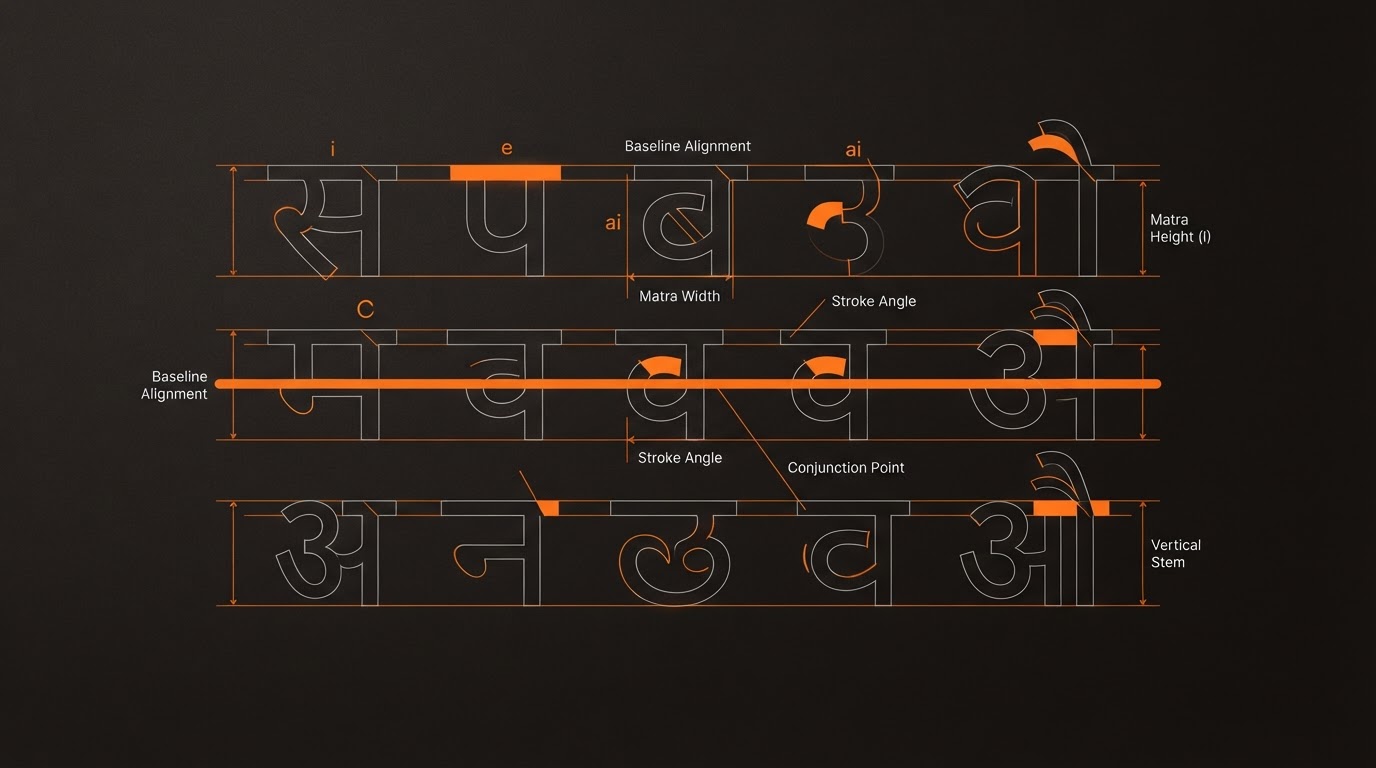
Beyond Hindi: Captioning for Tamil, Telugu, Marathi and Bengali
India is not one language market. What changes technically and editorially when you caption in four more scripts.
Summary — the short answer
- India is not one language market, and a Hindi-first caption workflow does not transfer cleanly to Tamil, Telugu, Marathi or Bengali.
- Marathi shares Devanagari with Hindi, so it is the cheapest expansion — but its vocabulary and code-mixing patterns differ.
- Tamil, Telugu and Bengali each need their own font, line height and conjunct handling.
- Word-level timing gets harder because word boundaries differ from Latin conventions, particularly in agglutinative Telugu.
- Do not machine-translate a Hindi script and caption the output. Write or transcribe in the target language.
Key facts
- Scripts covered here
- 4 beyond Devanagari-Hindi
- Cheapest expansion
- Marathi (same script)
- Hardest word segmentation
- Telugu
- Line height range
- 1.28–1.4
- Font strategy
- One family per script
- Never do
- Machine-translate then caption
A creator who has solved Hindi and Hinglish captions often assumes the rest of India is a copy-paste. It is not. Tamil, Telugu, Marathi and Bengali audiences are large, commercially serious, and each brings genuine technical differences to captioning. Treating them as variants of Hindi produces captions that native readers immediately recognise as careless.
What actually changes, script by script
| Language | Script | Line height | Main technical issue |
|---|---|---|---|
| Hindi | Devanagari | 1.30–1.35 | Matra clipping, shirorekha merging |
| Marathi | Devanagari | 1.30–1.35 | Same script, different vocabulary |
| Bengali | Bengali | 1.30–1.35 | Dense conjuncts, matra above baseline |
| Tamil | Tamil | 1.28–1.32 | Long syllable clusters, wide glyphs |
| Telugu | Telugu | 1.35–1.40 | Stacked marks above and below |
Marathi: the cheap win, with a catch
Marathi uses Devanagari, so your Hindi typography settings transfer almost unchanged. The catch is editorial rather than technical. Marathi code-mixes with English differently from Hindi, uses different everyday vocabulary, and a Hindi-trained transcription model will quietly substitute Hindi words that a Marathi speaker would never use. The captions look right and read wrong.
Bengali: dense conjuncts
Bengali has a large inventory of conjunct forms, and they are visually dense at caption size. Breaking a line inside a conjunct produces a shape no reader recognises, so line breaking must be word-aware. Bengali also carries marks above the baseline, so it needs the same generous leading as Devanagari.
Tamil: wide glyphs, long clusters
Tamil glyphs are comparatively wide and syllable clusters run long, which means fewer words fit per line than in Hindi at the same point size. The common failure is keeping a four-word-per-line rule from an English preset; in Tamil that regularly overflows the safe area. Two to three words per line is often the correct limit.
Telugu: stacked marks in both directions
Telugu places marks both above and below the base character, sometimes simultaneously, so it needs the most vertical room of the five. It is also agglutinative — a single written word can carry what English expresses in four or five — which makes word-level caption timing genuinely harder. One long Telugu word may span two seconds of audio, and highlighting it as a single unit feels sluggish.
Font strategy
Do not look for one font that covers everything. A single family covering five Indic scripts will be a compromise in at least three of them. Choose one well-engineered family per script, and pick them so their weights and x-height relationships feel consistent — that consistency is what makes a multilingual channel look like one brand.
- Require a real bold weight for every script. Synthetic bold destroys Indic letterforms far more visibly than Latin ones.
- Check that the family includes the conjunct forms your language actually uses, not just the base characters.
- Pair each Indic face with a Latin companion, because code-mixing means English words will appear in the same line.
- Verify rendering on an actual Android device. Indic text shaping still varies between platforms more than Latin does.
- Keep one caption preset per language rather than one preset with a font swap — line height and stroke differ too.
Transcription quality is not uniform
Speech recognition quality across Indian languages is uneven, and it broadly tracks how much public training data exists. Hindi is best served. Bengali, Tamil and Telugu are usable and improving. Regional accents within each language add another layer of variance — Telangana Telugu and coastal Andhra Telugu are not interchangeable inputs.
- 1Expect to edit more in the first month of a new language than you ever did in Hindi. Budget the time rather than being surprised by it.
- 2Build a per-language dictionary of names, brands and technical terms — this is where automatic transcription fails most visibly.
- 3Never machine-translate a Hindi script and caption the translation. Write or record in the target language and transcribe that.
- 4Have a native speaker review the first five videos in a new language before you publish at volume.
- 5Keep the code-mixed English exactly as spoken. Tamil-English and Telugu-English mixing is as normal as Hinglish.
Translation gives you the meaning. Transcription gives you the voice. Captions need the voice.
Should you expand at all?
Adding a language multiplies your production work, so it should be a deliberate decision rather than an experiment. Three conditions make it worth it.
- Your analytics already show meaningful viewership from a region whose language you are not serving.
- You or someone on your team speaks the language natively. Outsourcing voice to a translator is where authenticity dies.
- The topic genuinely travels. Product reviews and how-to content travel well; culturally specific humour rarely does.
If only the first condition is true, captions in that language on your existing content are a much cheaper first step than producing separate videos. Start there and see whether the engagement justifies more.
5
scripts covered by this workflow
1
caption preset per language
2–3
words per line in Tamil
Frequently asked questions
Can I use my Hindi caption preset for Marathi?
Typographically, yes — both use Devanagari with the same line height and stroke needs. Editorially, no: vocabulary and code-mixing differ, and a Hindi-trained model will substitute words Marathi speakers do not use.
Which Indian language is hardest to caption well?
Telugu, generally. It needs the most vertical room for stacked marks, and its agglutinative words make word-level highlighting feel sluggish unless you highlight at the syllable-cluster level.
Should I machine-translate my Hindi videos into Tamil?
No. Translate-then-caption produces text that is technically correct and unmistakably foreign. Record in the target language and transcribe that recording.
Do I need a different font for each script?
Yes, in practice. One family covering five Indic scripts will compromise several of them. Choose one strong family per script and match their weights so the brand stays consistent.
Is code-mixing normal outside Hindi?
Very. Tamil-English, Telugu-English and Bengali-English mixing is as common as Hinglish, and captions should preserve it exactly as spoken.
How many languages should one creator run?
Usually one primary plus captions in a second. Producing original content in more than two languages well is a team-sized undertaking.
Sources & further reading
- Unicode — Devanagari code chartCharacter reference for Hindi and Marathi text handling.
- Unicode — Tamil code chartAuthoritative Tamil character and cluster reference.
- Unicode — Telugu code chartTelugu characters, including the stacked mark behaviour.
- W3C — international text layout requirementsFormal specification of Indic script layout behaviour.
- VerbCraft: Hindi captions and Devanagari typographyThe Devanagari baseline these rules extend from.
- VerbCraft: why Hinglish breaks most AI toolsCode-mixing behaviour that applies to every Indian language pair.
Use this article elsewhere
Copy a structured brief for ChatGPT, Claude, Perplexity or Gemini — it includes the key points and the canonical link so the assistant can cite VerbCraft properly.
https://verbcrafts.in/blog/regional-languages-beyond-hindi